
Every broadcast transport project needs a different mix of signals. One camera position may require 12G-SDI, Ethernet, control and power. Another may need audio, sync, GPIO and a return video path. Specifying fixed-function hardware for every requirement can quickly create unnecessary boxes, power supplies and cabling.
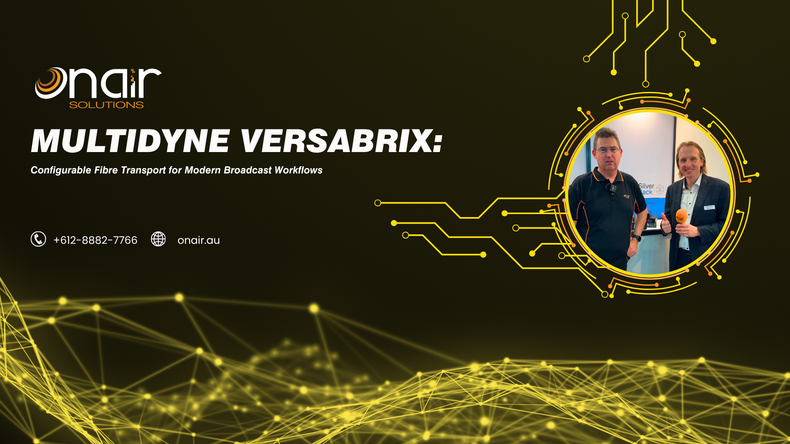
At BroadcastAsia 2026, Paul Dengate from OnAir Solutions spoke with Sebastian Mucha from MultiDyne about a more adaptable approach: the **MultiDyne VersaBrix VB Series**. The configurable platform allows broadcasters, production companies and AV integrators to build a compact fibre transport system around the signals a project actually needs.
A fibre platform built around the signal list
VersaBrix is a build-to-order platform rather than a single fixed transport product. System designers select a chassis and populate it with the appropriate VB cards for the required workflow.
Available signal options cover video, analogue and digital audio, serial data, tally, GPIO, sync and Ethernet. Current configurations extend as far as 12G-SDI and 10GbE, allowing one enclosure to support mixed broadcast and networked workflows. Depending on the design, each card can operate across its own fibre path, or multiple signals can be multiplexed onto one single-mode fibre.
This modular approach is useful when two locations need to carry different combinations of signals. A camera position might need SDI, control and network connectivity, while the equipment-room end may concentrate several links into a rack-mounted configuration. The transport hardware can be matched to each end without filling the system with unused connections.
MultiDyne also provides an [online VersaBrix configurator](https://configurator.multidyne.com/vb2/) so consultants and integrators can work through chassis, card and accessory options before finalising a design.
Video, control and power for PTZ camera systems
The BroadcastAsia demonstration used a Sony FR7 camera to show why configurable power can matter as much as signal transport. The FR7 requires 19.5 V power, which does not fit neatly into every conventional camera-extension design.
Sebastian explained how VersaBrix can be configured with external power options for devices operating between 5 and 24 V. The platform also offers 1GbE and 10GbE cards, including PoE++ options, allowing compatible cameras and accessories to receive network connectivity and power as part of the same system design.
This has practical value for PTZ installations where mains power is unavailable, inconvenient or undesirable at the camera position. It can reduce the number of separate devices required at the edge and make the complete camera package easier to deploy, service and relocate.
The same principle applies beyond the Sony FR7. The useful question is not simply, “How do we extend the video?” It is, “What does the complete camera position need?” That may include video, IP control, tally, serial data, sync and power, all of which should be considered before selecting the transport hardware.
Fibre and mounting choices for real installations
VersaBrix supports standard ST, LC and SC optical connections. The BroadcastAsia discussion also covered rugged remote-power workflows using LEMO and Neutrik opticalCON DUO connectivity.
The enclosures are designed for portable field use but can also be integrated into permanent systems. Available accessories include rack-mount kits, wall-mount hardware, battery plates and PTZ camera-mounting systems. This gives integrators options for placing the hardware directly with a camera, mounting it behind equipment or concentrating multiple units in a 19-inch rack.
That flexibility makes the platform relevant across several applications:
- PTZ and POV camera extension
- OB trucks and flypacks
- Studio-to-equipment-room links
- Sports and live-event venues
- Universities and corporate production facilities
- Long-distance video, audio, data and Ethernet transport
- Intercom, tally and control extensions
The hardware form factor can therefore follow the installation instead of forcing the installation to accommodate a standard box.
Four chassis sizes help avoid wasted space
The VersaBrix family includes four enclosure sizes:
- VT: two card slots
- V4: four card slots
- V6: six card slots
- VX: ten card slots
For a simple SDI and Ethernet extension, a two-card VT may be enough. Larger mixed-signal systems can move to the V4, V6 or VX without changing the underlying platform.
Rack density is equally practical. MultiDyne offers one-RU mounting kits for up to four V4 units, three V6 units or two VX units. This allows camera-side units to remain compact while the corresponding equipment-room hardware is installed cleanly in a central rack.
Selecting the smallest appropriate enclosure reduces unused capacity, weight and bulk. It also provides a clearer upgrade path: a project can choose a larger chassis where future expansion is likely without automatically oversizing every endpoint.
What to consider when specifying VersaBrix
A flexible platform still requires careful system design. Before selecting a configuration, document the complete requirement at both ends of the fibre link:
1. List every signal. Include primary and return video, audio, Ethernet, serial control, tally, GPIO, sync and intercom.
2. Confirm bandwidth and formats. Identify the required SDI rate, Ethernet speed and any future migration requirements.
3. Calculate the power requirement. Check device voltage, load, PoE class, redundancy and whether power must travel with the fibre.
4. Choose the fibre topology. Decide whether cards will use separate fibres or whether signals should be multiplexed onto one strand.
5. Select connectors for the environment. Permanent equipment rooms, portable production kits and exposed venue positions have different handling requirements.
6. Plan the mounting arrangement. Consider camera mounting, wall mounting, rack density, ventilation and service access.
These decisions are where OnAir Solutions can help. A correctly specified system should solve the complete transport requirement, not simply move one video signal from one end to the other.
Build the fibre system the workflow needs
MultiDyne VersaBrix is a strong fit for projects where the required combination of video, audio, data, Ethernet, control and power does not align with a fixed transport box. Its card-based design, range of chassis sizes and mounting options make it suitable for both portable production and permanent broadcast or AV infrastructure.
Explore MultiDyne products from OnAir Solutions, or contact our team to discuss the signals, power requirements and fibre topology for your next project.