
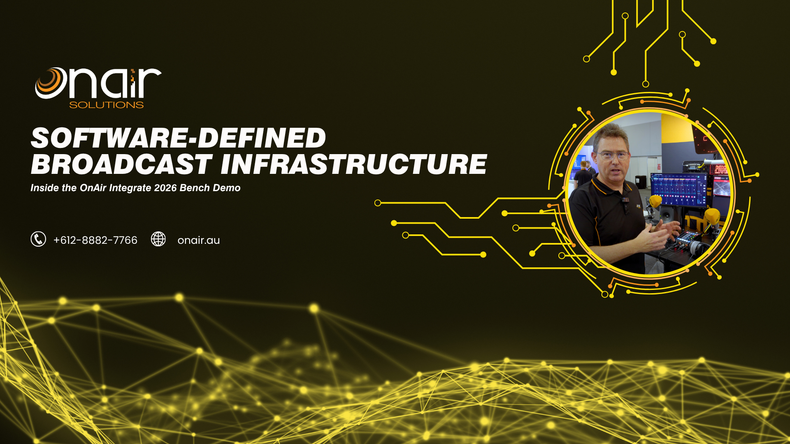
Modern broadcast facilities are evolving beyond dedicated hardware appliances. While specialised equipment remains essential, software-defined processing is becoming an increasingly important part of professional media infrastructure.
At Integrate 2026, OnAir demonstrated a complete software-defined studio that combines IP networking, broadcast audio processing and precision timing into a practical workflow built on open standards.
Building a Software-Defined Studio
The demonstration begins with a Sonifex commentator unit providing microphone, headphone and analogue connectivity. From there, audio is transported across the network using Dante and AES67 before entering the On-Hertz software DSP platform.
Unlike traditional DSP appliances, On-Hertz runs on standard computing hardware. The software can be deployed on a compact PC, virtual machine or cloud infrastructure, allowing facilities to select hardware that best suits their operational requirements.
This approach offers greater flexibility while maintaining professional broadcast capabilities.
IP Audio at the Core
Once audio enters the software environment, the workflow uses AES67 streams with Dante interoperability to move audio around the network.
For facilities adopting SMPTE ST 2110 workflows, NMOS support provides standardised discovery and control of networked resources.
The demonstration also highlights redundant audio transport, allowing primary and secondary network paths to operate simultaneously for improved resilience.
For broadcasters building critical infrastructure, redundancy remains a key requirement, and standards-based networking simplifies deployment across larger facilities.
Software Processing Without Compromise
The audio pipeline includes familiar processing tools such as:
- Equalisation
- Dynamics processing
- Gain control
- Routing
- Monitoring
- Metering
- Delay
- Stereo image control
Because the processing is software-defined, engineers can build workflows tailored to individual projects rather than being constrained by fixed hardware architectures.
Additional IP-based technologies, including SIP connectivity and NDI audio, are available within the same processing environment, reducing the need for multiple standalone devices.
Precision Timing Remains Essential
As with any IP media infrastructure, accurate timing underpins reliable operation.
The demonstration synchronises the system using a Meinberg Precision Time Protocol (PTP) Grandmaster, allowing the software platform to maintain accurate timing across networked audio streams.
For facilities adopting SMPTE ST 2110 or other IP media standards, robust PTP implementation is critical to achieving reliable synchronisation between devices.
Practical Applications
This style of architecture suits a broad range of environments, including:
- Broadcast studios
- Radio facilities
- Podcast production
- Remote production
- Corporate media
- Education
- Live event production
- Hybrid AV and broadcast systems
Rather than replacing hardware entirely, software-defined infrastructure complements dedicated broadcast equipment by providing greater scalability and flexibility.
Why It Matters
Broadcast technology continues to move toward open standards and IP-based workflows.
Software platforms such as On-Hertz demonstrate how processing, routing and monitoring can become more flexible while still integrating seamlessly with professional hardware from manufacturers such as Sonifex and timing systems from Meinberg.
For systems integrators, consultants and broadcasters, this means designing facilities that are easier to scale, simpler to adapt and better prepared for future workflows.
As organisations continue adopting SMPTE ST 2110, AES67 and NMOS, software-defined infrastructure is becoming another essential tool in the broadcast engineer's toolkit.