
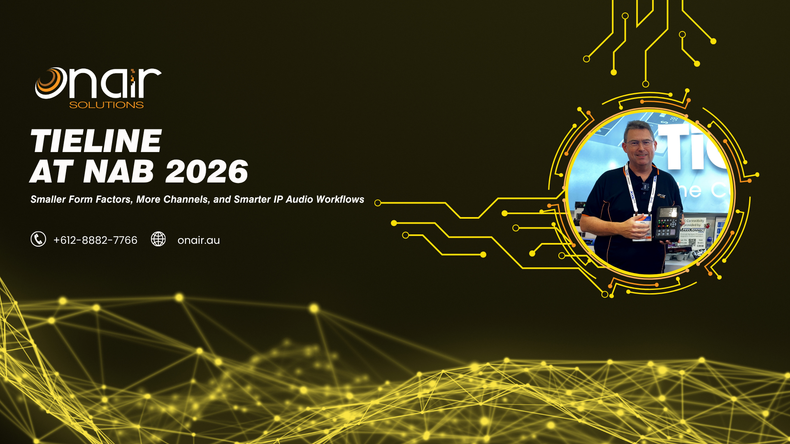
Tieline at NAB 2026, Smaller Form Factors, More Channels, and Smarter IP Audio Workflows
At NAB 2026, Tieline showed two product developments that speak directly to where broadcast audio workflows are heading. One is smaller and more portable, aimed at commentators and reporters working in the field or in remote production environments. The other goes the other way, delivering more channel capacity and deeper support for modern audio over IP workflows in fixed installations and larger systems.
In a Tech Take with Charlie Gourley from Tieline, Paul Dengate looked at both the new Duo and the new Gateway Nexus 32-channel codec, two products that reflect the growing demand for flexible, resilient, IP-based audio systems.
A smaller successor to the ViA
The ViA codec has built a strong reputation around the world, particularly for live contribution, remote commentary and reporter workflows. What Tieline has done with the Duo is take that proven concept and shrink it into a smaller form factor while retaining the kind of connectivity and flexibility users expect.
Tieline positions the Duo as a device designed for commentators and reporters alike, but what stands out is that it is not just a portable box with limited capability. It has been built around unified IP workflows, which makes it more relevant for modern production environments where hardware often needs to move between outside broadcast, remote production, studio and hybrid setups.
The Duo provides two mic/line inputs, support for 48V phantom power, and switchable AES3. That gives users the ability to work with a wide range of microphones and sources without needing extra conversion hardware. For field teams, sports commentary setups and lightweight contribution kits, that kind of flexibility matters.
There are also two Ethernet ports, which is important in any discussion around redundancy, network separation or integration into broader IP workflows.
Designed for REMI and modern commentary
One of the more interesting details in the transcript is the inclusion of HDMI output. In the context of REMI production, that becomes highly relevant. Tieline explained that the HDMI port supports video output for off-tube commentary, allowing commentators to work from a remote location while watching a program feed locally.
That feature helps position the Duo as more than just a traditional audio codec. It becomes part of a broader commentary solution, one that supports the operational realities of remote production where vision and audio need to come together in a simple, reliable way.
The touchscreen and menu structure also remain familiar to existing Tieline users. That is a practical advantage. In broadcast, familiarity reduces training time, speeds up deployment and lowers the chance of operator error in live environments.
AoIP support where it counts
Beyond its analogue and headphone connections, the Duo also includes four channels of AoIP. Tieline called out support for Dante, RAVENNA and SMPTE ST 2110-30, which places the unit firmly in the world of contemporary IP audio infrastructure.
This gives the Duo several possible roles. It can function as a commentary node, operate as a hybrid commentary node with codec capability, or fail over from commentary node operation to codec mode if connectivity is lost. That is a strong example of practical design thinking. Rather than building a single-purpose product, Tieline has created a more adaptable device that fits the unpredictable nature of live production.
For engineers and technical managers, that means one unit can cover multiple use cases across a network, reducing complexity and making deployments easier to standardise.
Gateway Nexus answers the call for more channels
The second major product discussed was the Gateway Nexus 32-channel codec. Where the Duo is about portability and flexibility at the edge of production, the Gateway Nexus is about scaling up.
Charlie Gourley explained that many customers using Gateway 16 units in data centres had been asking for more channels. The Gateway Nexus is Tieline’s response, delivering 32 channels of DSP and hardware-based AoIP in a platform designed for predictable latency.
That last point is significant. In software-driven and virtualised environments, variable latency can create real challenges for live audio workflows. Hardware that behaves predictably still has a strong place in professional broadcast, particularly where timing, confidence and consistency are essential.
The Gateway Nexus therefore looks like a product built for customers who want the benefits of IP audio without giving up the determinism that dedicated hardware provides.
Broad protocol support for real-world broadcast systems
The Gateway Nexus supports analogue and AES3 inputs and outputs, but the bigger story is on the AoIP side. Tieline listed support for Dante, RAVENNA, Livewire+, AES67 and SMPTE ST 2110-30, along with SMPTE ST 2022-7 for redundancy.
That support profile tells you exactly where the unit is intended to sit. This is a codec designed for modern mixed-protocol broadcast facilities, where interoperability matters and where reliability cannot be optional.
Tieline also referenced Ember+ and NMOS IS-04, IS-05 and IS-07. That broadens the story further. It means the Gateway Nexus is not just carrying audio, it is built to integrate into more sophisticated control, discovery and connection-management environments as well.
In plain terms, it is a product designed to slot into the kinds of IP ecosystems broadcasters are building now, not the ones they were building ten years ago.
Why these releases matter
Taken together, the Duo and the Gateway Nexus show a clear strategy. Tieline is addressing both ends of the market at once.
At one end, there is demand for smaller, more capable units that can serve commentators, reporters and REMI workflows without sacrificing professional connectivity or IP compatibility. At the other, there is demand for higher channel counts, stronger integration with AoIP standards, and hardware platforms that offer predictable performance in serious broadcast environments.
That is a sensible response to what many broadcasters, sports producers, systems integrators and infrastructure planners are dealing with today. Teams want gear that is easier to deploy, easier to integrate, and capable of working across both legacy and emerging workflows.
Final thoughts
Tieline’s NAB 2026 showing makes a strong case for where the brand is heading. The Duo looks set to appeal to anyone who has liked the ViA concept but wants something more compact and more closely aligned to current IP production methods. The Gateway Nexus, meanwhile, gives larger facilities and networked operations a more powerful platform for scalable, resilient audio transport.
For organisations working across commentary, remote production, broadcast contribution and AoIP infrastructure, both units deserve attention.
If you would like to know more about Tieline solutions or discuss a custom broadcast audio workflow, contact the team at OnAir Solutions at onair.au/contact-us